Is It Too Early to Care About Bone Density in Your Twenties?
Quick Answer: No - your twenties are the most important decade for bone health you will ever have. Peak bone mass is reached around age 25 to 30, and roughly 90 percent of it is laid down by 18 to 20. After that you maintain rather than build. The levers that matter are weight-bearing and resistance exercise, adequate calcium (around 1,000 mg daily) and vitamin D, sufficient overall energy intake, and regular menstrual cycles. Under-eating and over-training in this decade cost bone you cannot fully rebuild.
Here are the questions worth asking now, answered directly. This is general information, not medical advice.

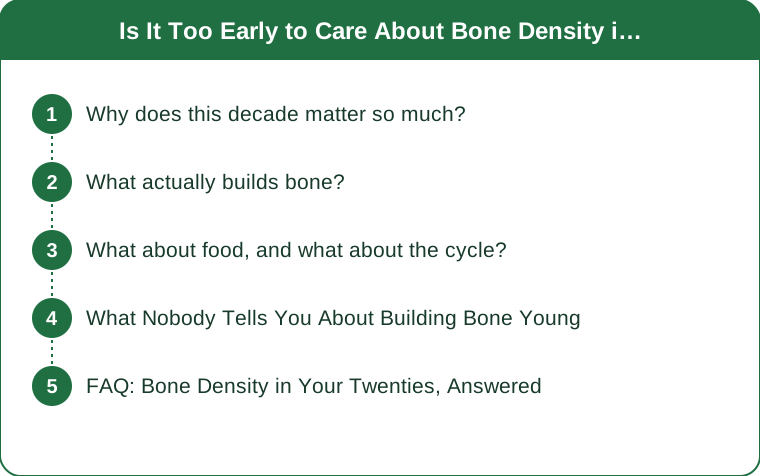
Why does this decade matter so much?
Bone is living tissue that is constantly being broken down and rebuilt. In childhood and adolescence, building outpaces breakdown; by your late twenties the two roughly balance, and later in life breakdown gradually wins.
Peak bone mass is reached around 25 to 30. Whatever total you reach then is the number you spend the rest of your life drawing down from, which is why the twenties are the last building window.
Around 90 percent is already laid down by 18 to 20. The remaining years still matter, but they are the final increments rather than the bulk of the work.
So is it already too late at 26?
No. You can still add a small amount, and far more importantly you can protect what you have. The habits established now determine the rate of decline over the next fifty years.
The consequences are decades away, which is exactly the problem. Nothing about low bone density is noticeable in your twenties, so there is no feedback signal at all until a fracture in your sixties.
Women have a specific reason to pay attention. Bone loss accelerates around menopause with declining oestrogen, so a higher starting peak provides meaningfully more buffer against that later drop.
What actually builds bone?
Loading it. Bone responds to mechanical stress, and specifically to loads that are heavier or more novel than it is used to.
Resistance training is the most effective form. Squats, deadlifts, lunges, and overhead pressing 2 to 3 times a week load the hip and spine, which are the sites that matter most later in life.
Impact matters too. Jumping, hopping, and running generate the ground reaction forces that stimulate bone formation. Ten to twenty jumps a day, done consistently, has measurable effects in research.
Does swimming or cycling count?
For cardiovascular fitness, absolutely. For bone, they do very little because they are not weight bearing. Athletes in these sports are often advised to add resistance training specifically for bone.
Progressive load beats light repetition. Lifting something moderately heavy for 6 to 10 repetitions stimulates bone more than very light weights for many repetitions.
Consistency beats intensity here. Bone adapts slowly - over months rather than weeks - so two years of steady training does far more than three months of hard training.
And walking alone is not enough. It is excellent for general health, but bone needs loads above what it already experiences daily, and walking is what your bones are already adapted to.

What about food, and what about the cycle?
Calcium around 1,000 mg daily for most adults. Dairy, fortified plant milks, tinned fish with bones, tofu set with calcium, and leafy greens all contribute. A glass of milk is roughly 300 mg, so this is achievable without much planning.
Vitamin D is required to absorb it. Between October and March at northern latitudes, sunlight is insufficient, and a daily supplement of 10 micrograms (400 IU) is commonly recommended over winter. Check the guidance for where you live.
Protein matters more than the old advice suggested. Bone is roughly half protein by volume, and adequate intake supports rather than harms bone density.
What is the biggest risk in this decade?
Under-eating relative to training load. Low energy availability disrupts hormones, and the resulting loss of regular menstrual cycles is directly associated with reduced bone density - sometimes substantially, and not fully reversible.
Missing periods is a signal, not an inconvenience. If cycles stop or become irregular in the context of training and dieting, that is a reason to see a doctor promptly, not something to work around.
Smoking and heavy drinking both reduce bone density, and both are far more common in this decade than later ones.
Very low body weight is an independent risk factor, separate from nutrition. This is general information, not medical advice - anyone concerned about their cycle, intake, or bone health should speak to a doctor.
What Nobody Tells You About Building Bone Young
The site is specific. Bone responds where it is loaded. Squats build hip and spine density; wrist curls do not build hip density. This is why programme choice matters more than general activity level.
Endurance athletes are frequently at higher risk, not lower. High training volume with inadequate energy intake and non-weight-bearing modalities is a genuinely risky combination that looks like peak health from the outside.
Hormonal contraception is a nuanced topic. Some methods have been associated with effects on bone density in younger users. It is worth an explicit conversation with your doctor rather than something to conclude from an article.
You cannot feel your bone density, and there is no everyday sign. Unlike almost every other health marker, there is no symptom to notice until something breaks.
DEXA scans are not routine in your twenties and are not usually needed without specific risk factors. The absence of a scan is not a reason to ignore the habits.
Ten jumps a day is a genuinely researched intervention. It sounds trivial and it is supported - brief, high-impact loading is one of the most efficient stimuli available.
And the compounding is real. A slightly higher peak at 28 means a slightly later crossing of the fracture-risk threshold at 68, which is the entire point of caring about this now.
FAQ: Bone Density in Your Twenties, Answered
When do you reach peak bone mass?
Around 25 to 30, with roughly 90 percent already laid down by 18 to 20. After that you are maintaining rather than building.
What is the best exercise for bone health?
Resistance training - squats, deadlifts, lunges, overhead press - 2 to 3 times a week, plus some impact such as jumping or running. Bone responds to load above what it is used to.
Does swimming help my bones?
Not meaningfully. It is excellent cardiovascular exercise but not weight bearing, so swimmers and cyclists are often advised to add resistance training specifically for bone.
How much calcium do I need?
Around 1,000 mg daily for most adults, from dairy, fortified plant milks, tinned fish with bones, calcium-set tofu, and leafy greens.
Do I need a vitamin D supplement?
At northern latitudes, generally yes between October and March, commonly 10 micrograms (400 IU) daily. Check the specific guidance where you live.
Why do missing periods matter for bones?
Loss of regular cycles usually reflects low energy availability and hormonal disruption, which is directly associated with reduced bone density and is not always fully reversible. See a doctor promptly if this happens.
Should I get a bone density scan?
Not routinely in your twenties without specific risk factors. Focus on the habits rather than the measurement, and discuss testing with a doctor if you have concerns.
Is it too late if I am already 29?
No. You may add a little, and you can significantly influence how slowly you lose it over the following decades. This is general information, not medical advice.
TL;DR:
- Peak bone mass arrives around 25 to 30, with 90 percent laid down by 18 to 20. This is the last building decade.
- Resistance training 2 to 3 times weekly - squats, deadlifts, lunges, overhead press - loads the hip and spine that matter later.
- Add impact: 10 to 20 jumps a day is a small, well-supported intervention.
- Swimming and cycling do very little for bone. Add lifting if they are your main sports.
- Calcium around 1,000 mg daily, plus vitamin D through winter at northern latitudes.
- Under-eating is the biggest risk in this decade. Lost or irregular periods are a medical signal, not an inconvenience.
- You cannot feel bone density - there is no symptom until a fracture decades later.
A higher peak now means a later crossing of the risk threshold in your sixties. This is general information, not medical advice.
Keep Reading
This article is for general informational and styling purposes only. Fit, sizing, and product availability may vary.