Recovery in Your Twenties, Questions Answered
Quick Answer: Recovery capacity does not fall off a cliff in your twenties. What changes is the amount of accumulated stress, irregular sleep, alcohol, and sitting that you are asking it to absorb, plus the disappearance of the incidental activity that student life provided for free. The physiology is largely intact; the inputs changed.
At twenty-two you slept badly, ate whatever, trained hard, and felt fine. At twenty-seven the same week leaves you flattened, and someone helpfully tells you it is because you are getting old.
You are not getting old. Almost everything about your life changed at the same time, and recovery is the system that shows it first.

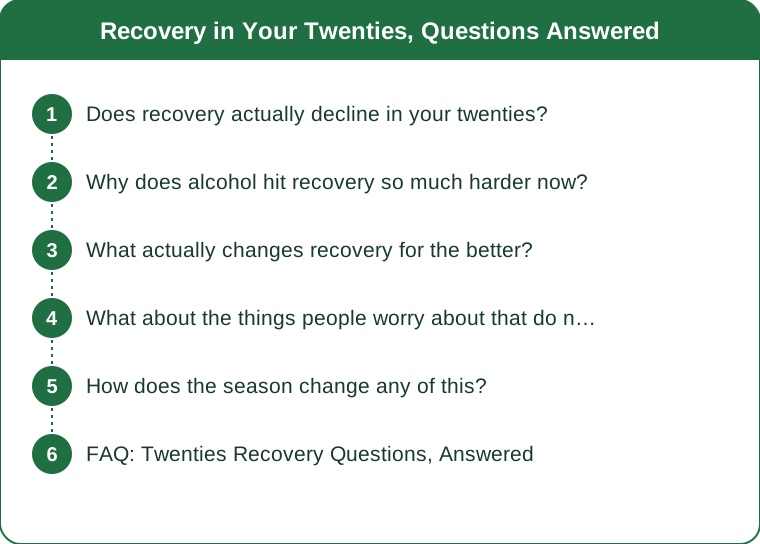
Does recovery actually decline in your twenties?
Barely, in terms of raw physiology, and substantially in terms of what you experience. Both things are true and the distinction matters.
The physiological decline through your twenties is genuinely small. Muscle repair, hormonal function, and sleep architecture change slowly across a lifespan, and the twenties are not where the meaningful drop happens. If you compared a well-rested, well-fed twenty-seven-year-old to a well-rested twenty-two-year-old, the difference would be modest.
What changes enormously is the context. Between twenty-two and twenty-eight, most people acquire a desk job, lose the walking that campus life built in, start sleeping to an alarm on a schedule set by someone else, add commuting, and pick up a background level of stress that does not switch off.
Chronic stress genuinely impairs recovery. Elevated stress hormones over long periods interfere with tissue repair and sleep quality, and the mechanism is well established. The twenties are frequently the decade with the steepest rise in sustained, unresolved stress.
And sleep gets worse in ways that are easy to miss. Not necessarily shorter, but more irregular, more alcohol-affected, and more often at the wrong time relative to your body clock. Sleep regularity turns out to matter nearly as much as sleep duration.
So the honest answer is: the engine is fine, the fuel and the maintenance schedule changed.
Why does alcohol hit recovery so much harder now?
Because the dose is the same but the buffer around it disappeared, and because a few genuine physiological factors shift.
Alcohol disrupts sleep architecture even when it does not shorten sleep. It suppresses the restorative deep stages early in the night and fragments the second half. You sleep the same hours and recover considerably less from them. That was always true - at twenty-two you simply had the luxury of an unstructured next day to absorb it.
The buffer is what changed. A rough night at twenty-two was followed by a late start, a nap, and no consequences. At twenty-seven it is followed by an alarm, a commute, and a full day where the deficit compounds instead of clearing.
Alcohol also impairs muscle protein synthesis and rehydration, which matters much more when you are training seriously than when you are casually active. Drinking after a hard session measurably reduces what you get from it.
And recovery from alcohol appears to slow modestly through the decade - inflammatory responses and dehydration take longer to resolve. The effect is real and smaller than the sleep and buffer effects.
The practical framing that helps most people: a night of drinking is not a standalone event, it is a withdrawal from the same recovery account that training and stress draw on. In a week with a hard training block and a work deadline, it is the third simultaneous demand rather than an independent one.
What actually changes recovery for the better?
A short list, in rough order of impact for most people in their twenties.
Sleep regularity, not just duration
Going to bed and waking at consistent times has effects comparable to adding sleep. Irregular timing - the classic weekday-weekend swing - produces a jet-lag-like effect that shows up as fatigue on Monday and Tuesday. Narrowing the weekend shift to an hour or so is usually the single highest-return change available.
Actual rest days, taken seriously
A rest day with eleven thousand steps, a long day on your feet, and four hours of standing at a social thing is not a rest day. It is a lighter training day. Real recovery needs at least one genuinely low-demand day per week.
Enough protein and enough total food
Under-eating is extremely common in this decade and it presents as poor recovery rather than as hunger. If sessions that used to feel fine now leave you flat for two days, the calorie total is worth checking before the training plan is.
Managing the stress that has no off switch
Work stress, financial stress, and relationship stress all draw from the same pool as training stress. You cannot always reduce the input, and you can build in genuine downregulation - a walk without a phone, a few minutes of slow breathing, anything that reliably takes the nervous system down a gear.
Movement on non-training days
Easy walking improves recovery rather than impairing it. The instinct to be completely sedentary on rest days is usually counterproductive.

What about the things people worry about that do not matter much?
Worth knowing, because attention spent here is attention not spent on sleep.
Ice baths and cold plunges
Genuinely useful for acute recovery between same-day efforts, and they may blunt some of the muscle adaptation you were training for if used immediately after strength sessions. Pleasant, sometimes helpful, not the foundation.
Expensive recovery devices
Massage guns, compression boots, and similar feel good and provide modest short-term relief. None of them substitute for a consistent bedtime, and a lot of people in their twenties buy them while sleeping six irregular hours.
Supplements for recovery
Most of the category is unnecessary if the diet is adequate. Where there are genuine gaps - and vitamin D in low-sunlight months is a common one, particularly as autumn arrives - a blood test and a doctor’s input is the right route rather than guesswork.
Stretching to prevent soreness
Static stretching after training has little effect on delayed onset muscle soreness. Do it because it feels good and because mobility matters, not as a recovery intervention.
Tracking every metric
Wearables can be useful for spotting trends, and they also produce anxiety about numbers that then genuinely worsens sleep. If your recovery score is making you sleep badly, the device is now the problem.
And one genuine caveat: persistent fatigue that does not respond to more sleep and less training is worth a doctor’s visit rather than a training adjustment. Thyroid function, iron levels, and vitamin D are common, checkable causes and they are more prevalent in young women than most people realize. This is general information, not medical advice.
How does the season change any of this?
More than most people expect, and predictably.
Daylight shrinks and body clocks drift. Less morning light makes it harder to wake at a consistent time and easier to drift later, which attacks the regularity that matters most. Getting outdoor light within an hour of waking is the cheapest correction available and it works.
Activity levels drop without anyone deciding to. The walking, cycling, and outdoor time that summer supplies for free disappears with the light and the weather, and total daily movement falls sharply. Recovery is better with a background of easy movement, so this hurts twice.
Social calendars get denser from autumn onward, which means later nights and more alcohol at exactly the point when the light is already pushing your body clock around.
And illness season starts. Under-recovered training raises susceptibility, and the first properly cold weeks are when it shows.
The practical autumn adjustments: protect the wake time even as the mornings get dark, get outside in the morning light when you can, deliberately schedule the movement that summer used to supply automatically, and treat a dense social month as a reason to reduce training volume rather than to add stimulants and push through.
None of this is about aging. It is about noticing that the inputs changed and adjusting the plan to match.
FAQ: Twenties Recovery Questions, Answered
Is it normal to need more sleep at twenty-eight than at twenty-two?
Sleep need is fairly stable through adulthood. What usually changed is that at twenty-two you took naps and slept in, so you were getting more sleep than you thought, and now you are not.
Do I need to stop drinking entirely to recover well?
No. The useful framing is placement - avoiding it in the twenty-four hours after hard sessions and before important ones, and not stacking a heavy social week onto a heavy training block. Total abstinence is a choice, not a requirement.
Why do I feel worse after a rest day than after training?
Often because the rest day was not restful, and sometimes because stopping lets accumulated fatigue surface. If two easy days in a row leave you feeling worse rather than better, that is a signal to look at total stress, food intake, or a possible underlying cause with a doctor.
How long should it take to feel recovered from a hard session?
For most people, twenty-four to forty-eight hours for general fatigue and up to seventy-two for heavy lower body work. Consistently needing longer than that is information about your sleep, food, or overall load rather than about your age.
TL;DR:
- Physiological recovery capacity barely declines through your twenties - what changed is accumulated stress, sleep regularity, alcohol placement, and the loss of incidental daily movement.
- Sleep regularity is the highest-return lever, often more than total duration, and the weekday-weekend swing is the usual culprit.
- Alcohol has always disrupted sleep architecture; what disappeared is the unstructured next day that used to absorb it.
- Cold plunges, devices, and supplements are secondary - and persistent unexplained fatigue is worth a doctor’s visit rather than a training tweak.
Autumn compounds all of it by removing light and free movement at once. Adjust the inputs and the recovery you remember is largely still there.
Keep Reading
This article is for general informational and styling purposes only. Fit, sizing, and product availability may vary.