What Actually Changes About Your Skin in Your Mid-Twenties
Quick Answer: Collagen production begins declining in the mid-twenties, at roughly 1 percent per year, and cell turnover slows from around 28 days toward 30-plus. That is why skin recovers more slowly and looks less immediately bright. Meanwhile oil production is still high enough to cause breakouts — so mid-twenties skin is genuinely both, and a routine built for teenage oiliness stops working.
Something shifts around 24 or 25.
A late night shows on your face the next morning in a way it never used to. You are still breaking out. And the moisturizer you have used since high school suddenly feels like it is doing nothing.
All three of those are the same story, and it is a fairly short list of actual changes.

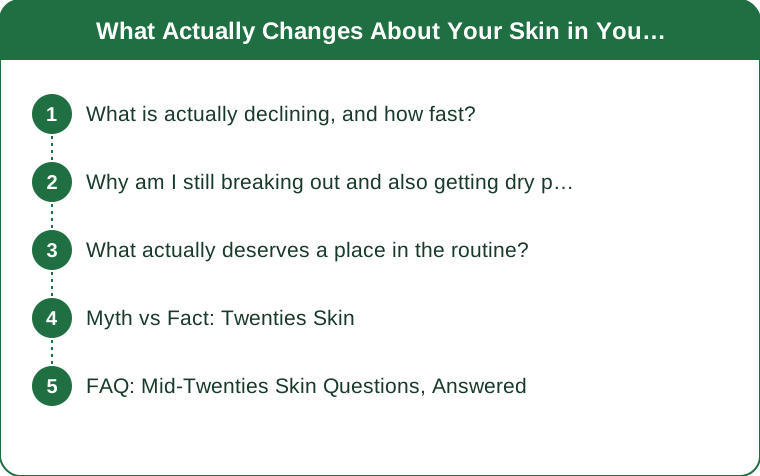
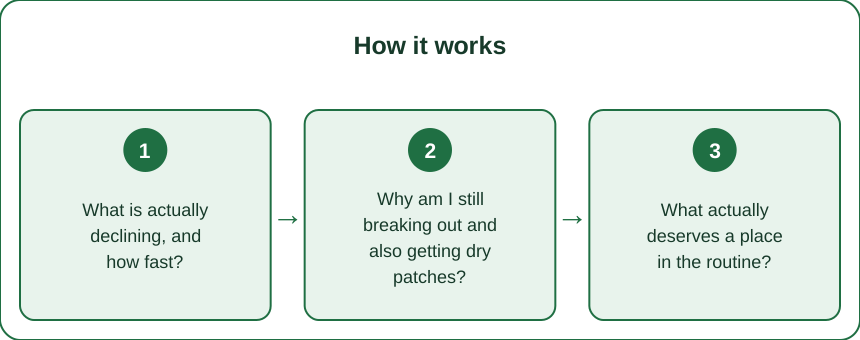
What is actually declining, and how fast?
Three measurable things, none of them dramatic year to year.
Collagen production. Collagen is the structural protein that keeps skin firm and elastic. Production peaks in the late teens to early twenties and then declines by roughly 1 percent per year. At 25 that is invisible. It is the reason prevention now is worth far more than correction later, because the decline is cumulative and steady rather than sudden.
Cell turnover. Skin cell turnover takes roughly 28 days in your twenties and gradually lengthens. Slower turnover means dead cells sit on the surface longer, which is what reads as dullness and slightly rougher texture. It is also why exfoliation starts producing more visible results than it did at 18.
Barrier recovery speed. Your skin barrier still repairs itself well in your twenties, but slightly more slowly than it did. So a harsh product, a cold dry week, or a night of no sleep takes longer to bounce back from.
What has not changed much at 25: oil production, which typically stays close to its peak into the late twenties. That combination — declining structure, still-active oil — is what makes mid-twenties skin feel contradictory.
Why am I still breaking out and also getting dry patches?
Because those are two different mechanisms and both can be active at once.
Breakouts in your mid-twenties are usually driven by some combination of hormonal fluctuation, stress, and follicle behavior — often along the jaw and chin rather than the T-zone pattern of teenage acne. The distribution changing is one of the most common observations at this age.
Dryness, meanwhile, is usually a barrier issue rather than an oil issue. Over-cleansing, over-exfoliating, harsh actives and cold weather all damage the lipid barrier, which lets water escape. You can have plenty of oil and a compromised barrier simultaneously — oily and dehydrated is a real and very common state.
The trap is treating the breakouts with the tools you used at 16: strong cleansers, high-strength benzoyl peroxide, astringent toners, aggressive scrubs. Those worked on skin with an aggressive oil response and a fast-recovering barrier. On mid-twenties skin they strip the barrier faster than it repairs, which produces dryness, irritation, and often more breakouts as the skin responds.
So the shift is from stripping to supporting. Gentler cleansing, consistent moisturizing, and targeted treatment rather than whole-face aggression.

What actually deserves a place in the routine?
A short list, and the order of priority is not what most product marketing suggests.
Sunscreen, daily, non-negotiable. UV exposure is responsible for the large majority of visible skin aging — commonly cited around 80 percent of it. Nothing else you can buy comes close to this in effect. SPF 30 or higher, every day, including cloudy days and including fall, when UVA levels stay meaningfully high even as it gets cooler.
A gentle cleanser. Once or twice a day. If your face feels tight after washing, the cleanser is too strong.
A moisturizer you will actually use. Look for ceramides, glycerin, or hyaluronic acid. This is barrier support, and it matters more in your twenties than any anti-aging claim.
A retinoid, eventually. Retinoids are the best-evidenced topical for both texture and collagen support. Starting in the mid-to-late twenties is reasonable. Start low and slow — twice a week, a pea-sized amount, at night — and expect an adjustment period. Retinoids and sun exposure need to be paired with the sunscreen above.
Vitamin C in the morning, optional but useful. An antioxidant that supports collagen and works alongside sunscreen.
What you can skip: a ten-step routine, anything promising to rebuild collagen through a cream alone, and most of the products aimed at 40-year-old concerns. Consistency with four products beats inconsistency with twelve.
Myth vs Fact: Twenties Skin
Myth: Anti-aging products are pointless until your thirties. Fact: Sunscreen and retinoids are prevention, and prevention works on a decline that has already started. Waiting until damage is visible is the expensive path.
Myth: Oily skin does not need moisturizer. Fact: Oil and hydration are different things. Skipping moisturizer on oily skin damages the barrier, and a damaged barrier often responds by producing more oil.
Myth: Expensive skincare works better. Fact: The best-evidenced ingredients — sunscreen filters, retinoids, niacinamide, ceramides — are available at drugstore prices. Formulation quality varies, but the price-to-benefit curve flattens fast.
Myth: You should exfoliate to fix dullness. Fact: Gentle chemical exfoliation once or twice a week can help slowing turnover. Daily scrubs damage the barrier and produce the dullness they are meant to fix.
Myth: Drinking water clears your skin. Fact: Dehydration is bad for you generally, but topical barrier care affects skin water loss far more directly than fluid intake does. Sleep has a better-supported connection to skin appearance than water volume.
FAQ: Mid-Twenties Skin Questions, Answered
Do I really need sunscreen in fall and winter?
Yes. UVA — the wavelength most associated with aging — stays relatively constant across seasons and passes through window glass. If you keep one habit year-round, this is the one.
How long before a new product shows results?
Give most things 8 to 12 weeks. Cell turnover takes about a month, so anything judged after two weeks is being judged on hydration, not on actual change. Switching products every three weeks is why routines stall.
Is my diet causing breakouts?
Evidence is strongest for high-glycemic diets and, for some people, dairy — both modest effects, both individual. It is worth a genuine four-week test rather than a permanent restriction on suspicion.
What about sleep and stress?
Both have real, documented effects on skin barrier function and inflammation. A consistent sleep schedule does more for your face than most serums, which is unsatisfying but true.
When should I see a dermatologist?
Persistent acne that over-the-counter products have not touched in three months, anything scarring, any changing mole, or sudden unexplained changes. Earlier is cheaper than later with acne specifically, because scarring is much harder to treat than active acne. This is general information, not medical advice.
TL;DR:
- Collagen declines about 1 percent a year from the mid-twenties, and cell turnover slows — that is the slower recovery you are noticing.
- Oil production is still near its peak, so being oily and barrier-compromised at once is normal and very common.
- Stop stripping. Gentle cleanser, real moisturizer with ceramides, daily SPF 30+, and a retinoid started low and slow.
- Judge products at 8 to 12 weeks, not two, and keep sunscreen going through fall — UVA barely changes with the season.
Your skin did not turn on you at 25. Two slow changes started, oil stayed put, and a routine built for 16 stopped matching any of it.
Keep Reading
This article is for general informational and styling purposes only. Fit, sizing, and product availability may vary.