Is It Normal to Feel Exhausted All the Time in Your Twenties? Here's the Real Answer
Quick Answer: Chronic exhaustion in your twenties is common but not ‘normal’ in the sense of being unavoidable — it’s usually driven by irregular sleep schedules, decision fatigue from a newly unstructured adult life, and underestimating how much recovery a demanding job or social life requires. It’s manageable with specific changes, not just something you have to push through.
Your twenties are supposed to be the energetic decade, so constant tiredness feels like something is uniquely wrong with you. In most cases, it’s a predictable byproduct of the specific lifestyle shift this decade brings — not a mystery.

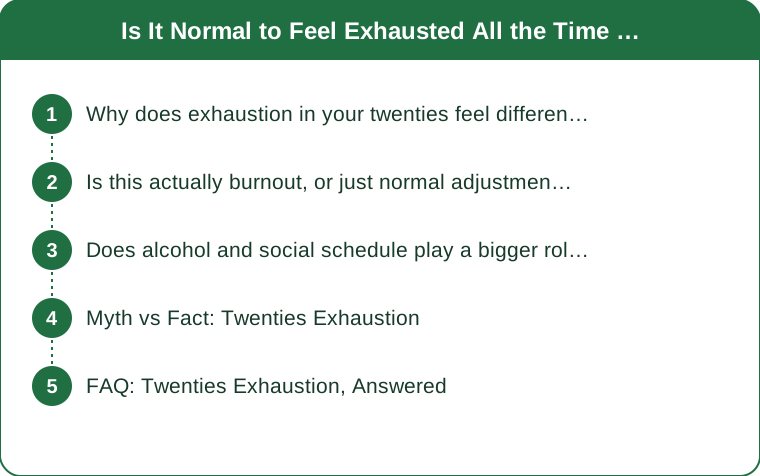
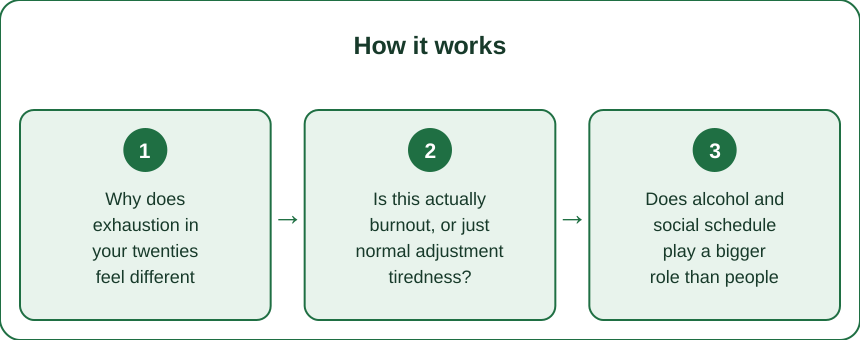
Why does exhaustion in your twenties feel different from being tired as a teenager or student?
The structure disappears. School and college enforce a rhythm — set class times, predictable schedules — that most twenty-something jobs and social lives don’t. Without that external structure, sleep and wake times drift, and inconsistency itself is a major driver of fatigue, independent of total hours slept.
Add in the decision fatigue of managing rent, bills, career choices, and social obligations without a built-in routine, and the mental load alone can produce physical tiredness that has nothing to do with how much sleep you’re getting.
Is this actually burnout, or just normal adjustment tiredness?
The distinction matters. Normal adjustment tiredness responds to a good night’s sleep and a lighter week — you feel noticeably better. Burnout persists even after rest, comes with a sense of dread about work or responsibilities, and often includes cynicism or detachment that a single good weekend doesn’t touch.
If a week of prioritized sleep and lighter obligations doesn’t meaningfully improve how you feel, that’s a signal this is closer to burnout than ordinary fatigue, and it may be worth talking to a doctor or therapist rather than just ‘pushing through.‘

Does alcohol and social schedule play a bigger role than people admit?
Yes, often more than diet or exercise. Even moderate drinking disrupts REM sleep significantly, and a social schedule packed with late nights compounds this into a chronic sleep debt that doesn’t fully resolve with one recovery night.
This isn’t about eliminating a social life — it’s about recognizing that a genuinely restorative week needs more than one or two full nights of quality sleep to offset several disrupted ones.
Myth vs Fact: Twenties Exhaustion
Myth: Feeling exhausted constantly is just part of being in your twenties. Fact: Common doesn’t mean unavoidable. Most cases respond well to consistent sleep timing and reduced decision fatigue — they’re not a permanent feature of this decade.
Myth: More caffeine is a reasonable fix for persistent tiredness. Fact: Caffeine masks the symptom without addressing the sleep debt or decision fatigue causing it, and can make falling asleep even harder, worsening the cycle.
FAQ: Twenties Exhaustion, Answered
How much sleep do most twenty-somethings actually need?
Most adults need 7-9 hours, and the twenties are no exception — the common belief that you need less sleep in your twenties isn’t well supported.
When should constant tiredness be checked by a doctor?
If fatigue persists despite consistent sleep, hydration, and a manageable schedule for several weeks, it’s worth ruling out underlying causes like anemia, thyroid issues, or depression. This is general information, not medical advice.
Does a consistent sleep schedule matter more than total hours slept?
Both matter, but consistency is frequently underrated — going to bed and waking at wildly different times each day disrupts your circadian rhythm even if the total hours add up.
TL;DR:
- Constant exhaustion in your twenties is common but usually explainable, not inevitable
- Loss of external structure (school schedules) is a bigger driver than most people realize
- Distinguish normal adjustment tiredness (responds to rest) from burnout (persists despite rest)
- Sleep consistency matters as much as total hours — and caffeine masks the real issue
If a lighter week and consistent sleep genuinely don’t help, that’s worth a conversation with a doctor, not just more coffee.
Keep Reading
This article is for general informational and styling purposes only. Fit, sizing, and product availability may vary.