How Do You Tell the Difference Between Being Tired and Actually Burned Out in Your Twenties?
Quick Answer: Ordinary tiredness resolves with rest and sleep; burnout persists even after adequate rest and comes with a specific cluster of cynicism, detachment from work you used to care about, and a sense of reduced effectiveness that sleep alone doesn’t fix. If a weekend of real rest doesn’t meaningfully reset how you feel about Monday, that’s a signal worth taking seriously rather than pushing through.
You slept eight hours. You had a genuinely relaxing weekend. And Monday still feels like wading through concrete — that gap between rest and how you actually feel is the tell.

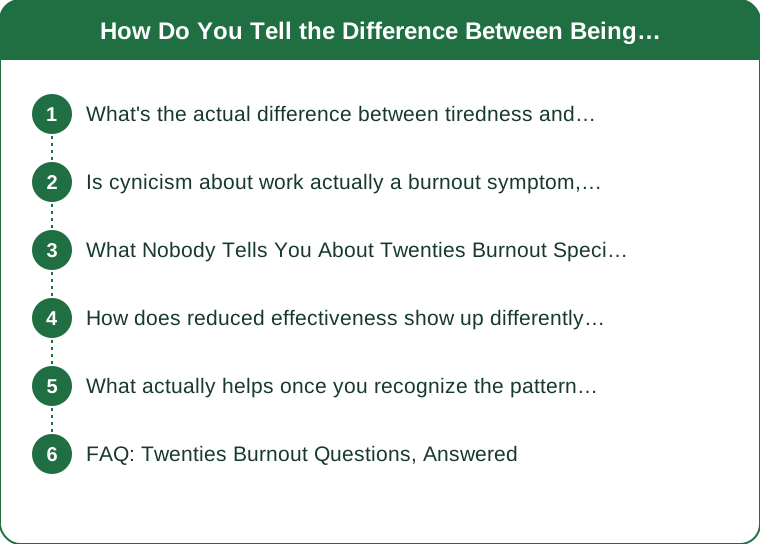
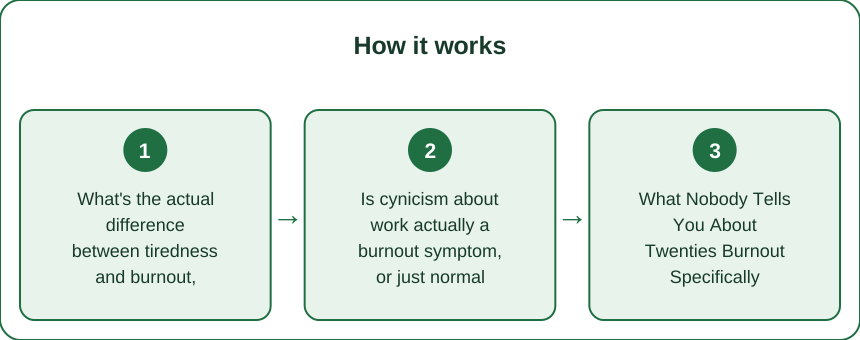
What’s the actual difference between tiredness and burnout, physiologically?
Tiredness is largely a sleep-debt and energy-depletion issue that responds predictably to rest, recovery, and time off. Burnout involves chronic stress hormone dysregulation built up over sustained periods of feeling both overworked and under-resourced — it doesn’t reset the same way because the underlying cause (the ongoing conditions, not just accumulated fatigue) hasn’t actually changed just because you rested for a weekend.
This is why ‘just take a vacation’ often provides only temporary relief for real burnout — the person returns to the same conditions that caused it, and the fatigue rebuilds quickly, sometimes within days.
Is cynicism about work actually a burnout symptom, or just normal disillusionment?
It can be either, but a specific, notable shift toward cynicism about work you previously found meaningful or at least tolerable is one of the more distinct burnout markers, separate from tiredness entirely. Ordinary job dissatisfaction tends to be more targeted (frustration with a specific manager, task, or situation); burnout-related cynicism tends to be broader and harder to pin to one specific cause.
This symptom is easy to miss in your twenties specifically, since some career disillusionment is genuinely normal at this stage and can mask a burnout pattern developing underneath it.
What Nobody Tells You About Twenties Burnout Specifically
Burnout in your twenties often looks different from the classic mid-career picture, because it frequently overlaps with genuine uncertainty about career direction, financial pressure, and the general instability common to this decade — which makes it easy to misattribute burnout symptoms entirely to ‘just being in your twenties’ rather than recognizing a specific, addressable pattern.
Additionally, twenties burnout sometimes gets reinforced by hustle-culture messaging that frames constant exhaustion as a normal, even admirable, part of early career building — which can delay recognizing burnout as a real problem rather than an expected rite of passage.

How does reduced effectiveness show up differently from just being tired?
Burnout-related reduced effectiveness tends to show up as difficulty starting tasks you’d normally handle easily, not just working slower — a specific kind of procrastination or avoidance that feels different from ordinary low-energy days. Simple tasks start to feel disproportionately effortful to begin, even when the actual task complexity hasn’t changed.
Ordinary tiredness usually still lets you push through and complete work, just with more effort than usual; burnout more specifically affects the ability to start or engage with work at all, which is a meaningfully different pattern.
What actually helps once you recognize the pattern, beyond just resting?
Addressing the underlying conditions, not just the fatigue — this might mean a genuine conversation about workload with a manager, reassessing whether a role or environment is sustainable, or setting firmer boundaries around after-hours availability. Rest and sleep still matter and shouldn’t be skipped, but they’re a supporting measure, not the actual fix, when burnout’s root cause is ongoing and unaddressed.
For persistent or severe burnout symptoms — including if they come with signs of depression or anxiety — talking with a mental health professional is a reasonable and often genuinely helpful step, separate from workplace-focused fixes.
FAQ: Twenties Burnout Questions, Answered
Can burnout happen even in a job you generally like?
Yes — burnout is more closely tied to sustained overwork and lack of resources or support than to whether you like the work itself; even meaningful, enjoyable work can produce burnout under the wrong conditions.
How long does burnout typically take to develop?
It varies significantly, but it’s usually a gradual buildup over months of sustained stress rather than a sudden onset, which is part of why it’s easy to miss until it’s fairly established.
Is switching jobs the only real fix for burnout?
Not always — sometimes addressing workload, boundaries, or support within the same role resolves it, though if the conditions genuinely can’t change, a job or environment change is sometimes the more realistic fix.
This is general information, not medical advice — persistent burnout symptoms, especially alongside low mood or anxiety, are worth discussing with a professional.
TL;DR:
- Ordinary tiredness resolves with rest; burnout persists even after genuine rest because the underlying conditions haven’t changed
- A specific, broad shift toward workplace cynicism is a distinct burnout marker, different from targeted job frustration
- Twenties burnout often gets misattributed to normal career uncertainty, which can delay recognizing it
- Difficulty starting tasks, not just working slower, is a telling sign that differs from ordinary fatigue
- Addressing underlying workload and boundary issues matters more than rest alone for real recovery
If a genuinely restful weekend doesn’t meaningfully shift how Monday feels, that gap itself is the signal worth listening to — not something to push through with more caffeine and willpower.
Keep Reading
This article is for general informational and styling purposes only. Fit, sizing, and product availability may vary.