Why Two Coffees Stopped Working in Your Twenties — Questions, Answered
Quick Answer: Caffeine tolerance is real and it develops fast — your brain adds adenosine receptors in response to regular caffeine, so the same dose blocks a smaller proportion of them. The result is that coffee stops feeling like a boost and starts feeling like the baseline you need to be normal. A partial reset takes about one to two weeks of a reduced, consistent dose, and moving your first cup 90 minutes later often helps more than cutting back does.
At nineteen, one coffee felt like a personality upgrade. Now you have had three, you are not really awake, and at 3pm you get flattened anyway.
Nothing is wrong with you and your metabolism did not break. The third question below is the one that actually changes people’s afternoons.

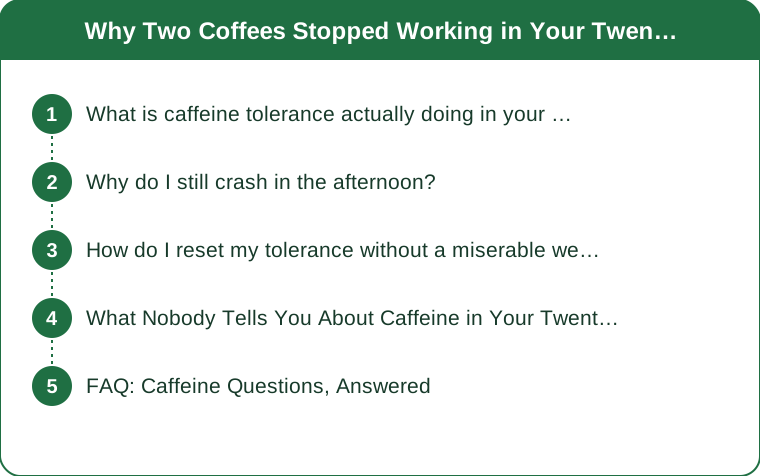
What is caffeine tolerance actually doing in your brain?
Why does the same amount stop working?
Caffeine does not give you energy — it blocks the signal that you are tired. Adenosine builds up in your brain across the day and binds to receptors that make you feel sleepy. Caffeine fits those same receptors without activating them, so the tiredness signal cannot land.
Your brain notices the blockade and adapts. It builds more adenosine receptors. Now your usual dose blocks a smaller share of the total, so you feel less of it — and when caffeine is absent, you have more receptors available for adenosine to bind to, which is why you feel dramatically worse without it than you used to.
This adaptation begins within days of regular use and is measurable within one to two weeks.
Does tolerance affect everything caffeine does?
No, and this is the important nuance. Tolerance develops strongly for the alertness effect and much less completely for other effects — the increase in heart rate and the anxiety-provoking effects tend to persist. That is why heavy coffee drinkers often report jitteriness without alertness, which feels like the worst possible trade.
Is my genetics part of this?
Yes. Variation in the CYP1A2 enzyme means some people clear caffeine roughly twice as fast as others, and a variant in the adenosine receptor gene affects how much anxiety and sleep disruption you get. Someone who can drink an espresso after dinner and sleep fine is not more disciplined than you — they are a fast metabolizer.
Why do I still crash in the afternoon?
What is actually happening at 3pm?
Three things converge. Adenosine that was blocked has continued accumulating, so when caffeine levels fall, the backlog lands all at once. Your circadian rhythm has a genuine mid-afternoon dip that exists independently of caffeine or lunch. And if lunch was carbohydrate-heavy with little protein, you get a blood sugar swing on top.
The crash is not caffeine wearing off in isolation — it is caffeine wearing off while the other two are already happening.
Does drinking more coffee at 2pm fix it?
It patches the next two hours and moves the problem into your night. Caffeine has a half-life of roughly five to six hours, meaning a 2pm coffee still has a meaningful amount in your system at 8pm and a measurable amount at bedtime.
Research on caffeine and sleep has found that even doses taken six hours before bed can reduce total sleep time — and crucially, people often do not notice this subjectively. You fall asleep fine and sleep less deeply, wake tired, and need more coffee. That is the loop.
What actually helps at 3pm?
Ten minutes outside. Daylight exposure is a genuine alertness signal, and it does not borrow from tonight. A short walk, ideally in real daylight rather than by a window, does more for the afternoon dip than a fourth cup — and it has none of the sleep cost.

How do I reset my tolerance without a miserable week?
Do I have to quit entirely?
No, and quitting cold is usually the least sustainable option. Withdrawal headaches, fatigue, and irritability typically peak at 24 to 48 hours and last two to nine days, which is a rough price for something you can get most of by tapering.
What is the taper that actually works?
Cut by about 25 percent per week rather than all at once. Four cups to three, three to two, and so on, holding each level for a full week. Most people report noticeably restored sensitivity at a moderate consistent dose within two weeks without ever going through full withdrawal.
Aim to land at a dose you can hold indefinitely — for many people that is one to two cups, taken at the same time each day. Consistency matters more than the absolute number: an erratic pattern of one cup some days and four on others gives you the tolerance of the high days and the withdrawal of the low ones.
What is the delayed-first-cup trick?
This is the highest-value change and it costs nothing. Wait 60 to 90 minutes after waking before your first coffee.
The reasoning: cortisol peaks naturally in the first 30 to 45 minutes after waking, and you are already getting an alertness boost you did not pay for. Drinking coffee into that peak blunts the felt effect and shifts your dependence earlier. Waiting until the natural peak subsides means the same cup does noticeably more work — and your last dose of the day lands earlier, protecting your sleep.
Try it for four days. Most people notice by day three.
What Nobody Tells You About Caffeine in Your Twenties
The dose that stopped working was never the problem — the sleep debt underneath it was. Caffeine tolerance and chronic short sleep look identical from the inside. Both feel like needing more coffee. If you are averaging under seven hours, no tolerance reset will make you feel rested, because you are not treating tolerance, you are treating a deficit.
Energy drinks are not a different substance. A large can can hold as much caffeine as two or three coffees, delivered faster and often with sugar. The tolerance math is the same — the only difference is that the dose is easier to underestimate.
Pre-workout is caffeine too. People taper their coffee, keep a 200 mg pre-workout, and wonder why nothing changed. Add it up honestly, including tea, cola, dark chocolate, and anything labelled as an energy blend.
Afternoon caffeine is the sleep thief you do not notice. The reason this matters more in your twenties than it did at seventeen is that your schedule has stopped protecting you — nobody is making you go to bed, and the compounding runs quietly for years.
Tolerance comes back fast. After a reset, returning to a high daily dose rebuilds tolerance within one to two weeks. The reset is not a permanent fix; the sustainable dose is.
FAQ: Caffeine Questions, Answered
How much caffeine is generally considered fine?
For most healthy adults, up to about 400 mg per day — roughly four small brewed coffees — is the commonly cited guideline, with lower limits during pregnancy. Individual sensitivity varies hugely, and if you get palpitations, anxiety, or disrupted sleep, your personal ceiling is lower regardless of the guideline. This is general information, not medical advice.
Does switching to green tea help?
Somewhat, for two reasons. The dose per cup is lower, and green tea contains L-theanine, which some studies associate with a smoother subjective alertness alongside caffeine. It is a reasonable step down in a taper — but it is still caffeine, and it still counts toward your daily total and your cutoff time.
When should my caffeine cutoff be?
Count back at least eight hours from your bedtime, and ten if you are sensitive. For an 11pm bedtime, that means finishing by early afternoon. If you have never tested this, try a hard 2pm cutoff for one week and notice how you feel on waking — for a lot of people that single change does more than any tolerance reset.
TL;DR:
- Tolerance is your brain adding adenosine receptors — the same dose blocks a smaller share of them.
- Tolerance builds strongly for alertness and weakly for jitters, which is why heavy use feels like anxiety without focus.
- Taper by 25 percent per week instead of quitting cold; two weeks at a steady moderate dose restores a lot of sensitivity.
- Delay your first cup 60 to 90 minutes after waking — it is the cheapest and most noticeable change available.
- The 3pm crash responds better to ten minutes of daylight than to another coffee that costs you tonight’s sleep.
The thing about caffeine in your twenties is that it is the first habit that quietly compounds without anyone stopping you. Which also means it is one of the easiest to reset, if you treat it like a dial with a sustainable setting rather than a switch you either have on or off.
Keep Reading
This article is for general informational and styling purposes only. Fit, sizing, and product availability may vary.