Why Simple Decisions Feel Exhausting in Your Twenties — It's Decision Fatigue, Not a Character Flaw
Quick Answer: Your twenties often bring a sudden, sustained increase in independent daily decisions — career, finances, housing, relationships, health — with far less established routine than later life stages typically have, and decision fatigue (measurably worse decision quality and increased exhaustion after many small choices) accumulates from that sheer decision volume, not from any personal shortcoming.
Every independent decision draws from the same limited daily reserve, and your twenties often ask for more of them, more often, with less established routine to lean on than you’ll likely have later.

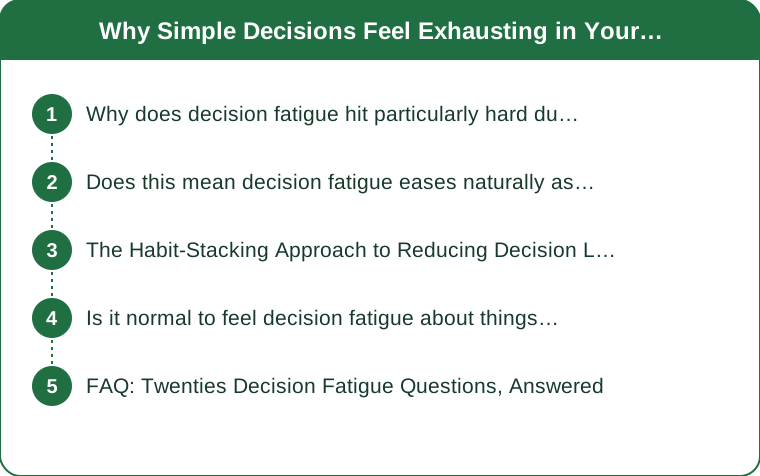
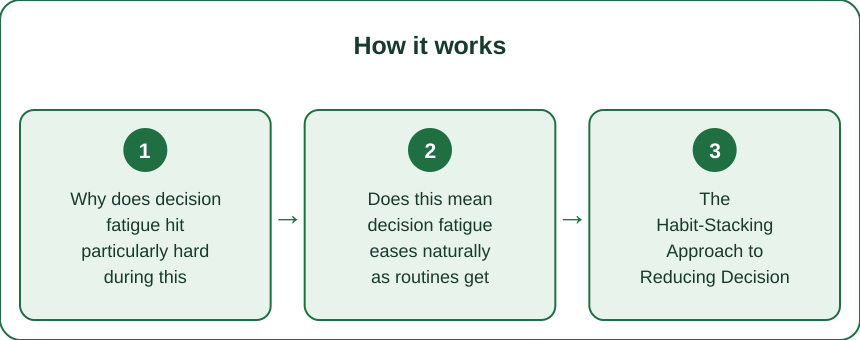
Why does decision fatigue hit particularly hard during this specific life stage?
Research on decision fatigue shows that decision-making quality and willpower draw from a shared, limited daily resource that depletes with use, regardless of how small each individual decision seems. Your twenties typically involve more first-time, independent decisions (without established routines to fall back on) than almost any other life stage — what to eat, where to live, how to manage money, career choices — all drawing from that same limited reserve simultaneously.
By the time a seemingly simple choice like dinner comes up, the reserve may already be significantly depleted by everything decided earlier in the day.
Does this mean decision fatigue eases naturally as routines get established?
Largely yes — established routines significantly reduce daily decision load by converting former decisions into automatic habits (a set morning routine, a regular meal rotation, an established budget system), which is part of why decision fatigue tends to ease somewhat in later life stages as more of daily life becomes routine rather than actively decided each time.
This is genuinely good news: the exhaustion isn’t a fixed personality trait, it’s a volume problem that responds well to deliberately building routine into areas that don’t need fresh decisions daily.

The Habit-Stacking Approach to Reducing Decision Load
Rather than trying to fix decision fatigue with willpower alone, strategically reducing daily decision volume in low-stakes areas frees up reserve for the choices that actually matter — a repeating weekly meal rotation, a simplified capsule wardrobe, or a set weekly schedule for recurring tasks all remove dozens of small decisions without requiring less overall functioning.
This mirrors a well-documented strategy used by many high-decision-volume professionals: deliberately minimizing trivial daily choices (like a consistent daily outfit) to preserve decision-making capacity for higher-stakes choices later in the day.
Is it normal to feel decision fatigue about things that used to feel easy in your teens?
Yes — many decisions that felt automatic in your teens (what to eat, when to sleep, how to spend free time) were actually being made or structured by parents, school schedules, or other external routine, not by you independently. Taking over full independent responsibility for decisions previously scaffolded by others is a genuine adjustment, not a sign you’re managing life worse than you used to.
This reframe alone often reduces some of the self-judgment that tends to compound the fatigue itself.
FAQ: Twenties Decision Fatigue Questions, Answered
Does decision fatigue affect food and eating decisions specifically more than others?
Food decisions are a commonly cited example since they recur multiple times daily, making them a high-frequency drain on the same limited decision reserve.
Can decision fatigue be reduced without eliminating choice and spontaneity entirely?
Yes — the goal is reducing trivial repeated decisions, not eliminating meaningful choice; a meal rotation still allows spontaneity on the days that matter most.
Is professional support worth considering if decision fatigue feels overwhelming?
If decision fatigue is accompanied by persistent overwhelm or difficulty functioning day to day, talking with a therapist or counselor can help build sustainable systems — this is general information, not clinical advice.
TL;DR:
- Your twenties often bring a sharp increase in independent decisions with less established routine to lean on
- Decision-making quality draws from a shared, limited daily reserve that depletes with use
- Building routine into low-stakes areas frees up capacity for decisions that actually matter
- Many teen-era ‘easy’ decisions were previously scaffolded by parents or school, not genuinely simpler
The exhaustion around simple choices isn’t a character flaw — it’s a decision-volume problem, and it responds well to deliberately building routine where it isn’t needed.
Keep Reading
This article is for general informational and styling purposes only. Fit, sizing, and product availability may vary.