Why Habits Formed in Your Twenties Tend to Stick Longer (The Actual Reason)
Quick Answer: Habits formed in your twenties tend to stick longer partly because this decade often has more routine flexibility (fewer entrenched life structures like established careers, mortgages, or children competing for time) and because research on habit formation suggests earlier-established routines have simply had more years to become deeply automatic by the time major life complexity arrives later.
It’s not that willpower is stronger in your twenties — it’s that the conditions for building and repeating a habit consistently are often more favorable than they become later.
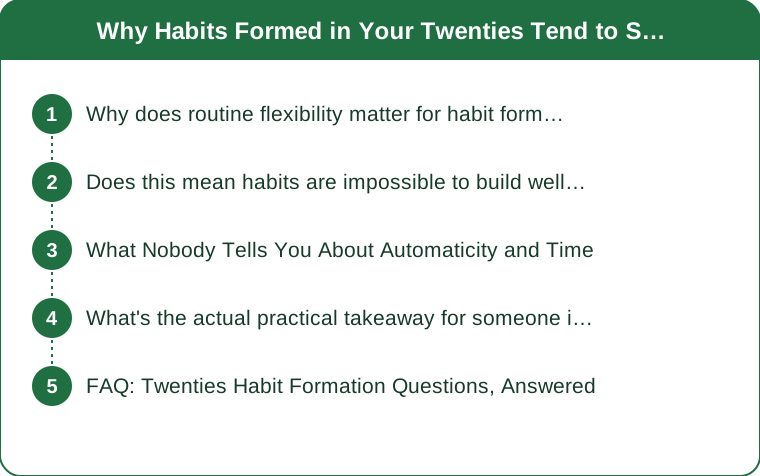
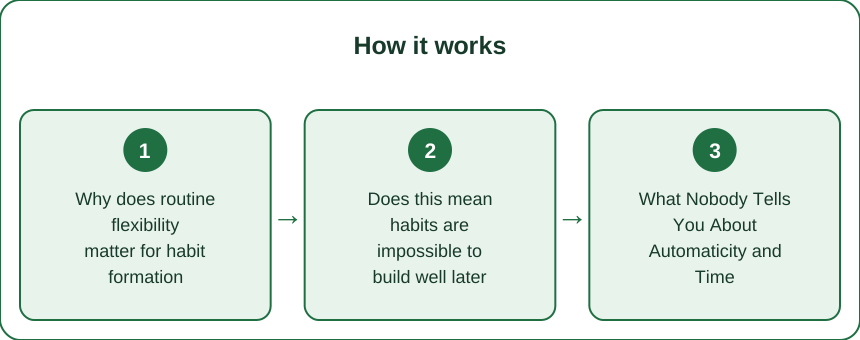
Why does routine flexibility matter for habit formation specifically?
Because habit formation depends heavily on consistent repetition in a relatively stable context — the twenties often (though not universally) involve fewer fixed obligations competing for the same time slot day to day, making it easier to protect a consistent habit window (a morning workout, a set bedtime) than once caregiving, demanding career stages, or other twenties-and-thirties life complexity increases scheduling unpredictability.
Does this mean habits are impossible to build well later in life?
No — habit formation research doesn’t show an age cutoff on ability to build new habits, just that the twenties often present fewer competing obligations, which is a circumstantial advantage rather than a biological one. Habits absolutely can be built successfully in the thirties, forties, and beyond; the twenties’ advantage is more about available consistency than any inherent capacity difference.
What Nobody Tells You About Automaticity and Time
A habit becomes genuinely automatic — requiring little conscious willpower — with enough repetition over time, commonly estimated in a wide range depending on habit complexity. A habit started at 24 has, practically speaking, had more total years to reach full automaticity by 34 than one started at 32 has by the same age — this compounding time advantage is part of why earlier-established habits often feel more effortless later.
What’s the actual practical takeaway for someone in their twenties right now?
Prioritize building 2-3 genuinely foundational habits deeply (consistent sleep schedule, regular movement, a sustainable eating pattern) rather than spreading effort across many superficial habits at once — the compounding automaticity advantage matters more for habits given focused, consistent repetition than for habits attempted broadly but inconsistently.
FAQ: Twenties Habit Formation Questions, Answered
Is there an ideal number of habits to focus on building at once?
Most habit formation research suggests focusing on 1-3 at a time significantly improves success rate compared to attempting many simultaneously, since willpower and attention are limited resources during the less-automatic early repetition phase.
Does habit stacking (attaching a new habit to an existing routine) actually help?
Yes — anchoring a new habit to an already-consistent existing routine (a habit you already do reliably) is a well-supported technique that speeds up the path to automaticity.
If you’re past your twenties, is it still worth investing heavily in new habit formation?
Absolutely — while the twenties may offer more routine flexibility for some, deliberate habit-building at any age still follows the same basic mechanism and remains genuinely effective with consistent effort.
TL;DR:
- Twenties habits often stick better due to routine flexibility, not inherently stronger willpower
- Habit formation has no hard age cutoff — it’s a circumstantial advantage, not biological
- Habits started earlier have simply had more years to reach full automaticity by any given later age
- Focus on 2-3 foundational habits deeply rather than many habits superficially, at any age
The twenties advantage is about available consistency, not capacity — deliberate habit-building works the same way at any age with the same focused approach.
Keep Reading
This article is for general informational and styling purposes only. Fit, sizing, and product availability may vary.