Why Do Hangovers Get Worse in Your Late Twenties Than They Were at 22?
Quick Answer: Yes, this is a real and measurable shift, not just perception — total body water percentage (which dilutes alcohol concentration) gradually declines starting in your mid-to-late twenties, and sleep quality, which is central to hangover recovery, also naturally becomes lighter and more easily disrupted around the same age, so the same amount of alcohol produces a genuinely rougher next day than it did at 22.
You had the same two drinks you always have. But the next morning feels categorically worse than it did a few years ago, and it’s not just that you’re imagining it.

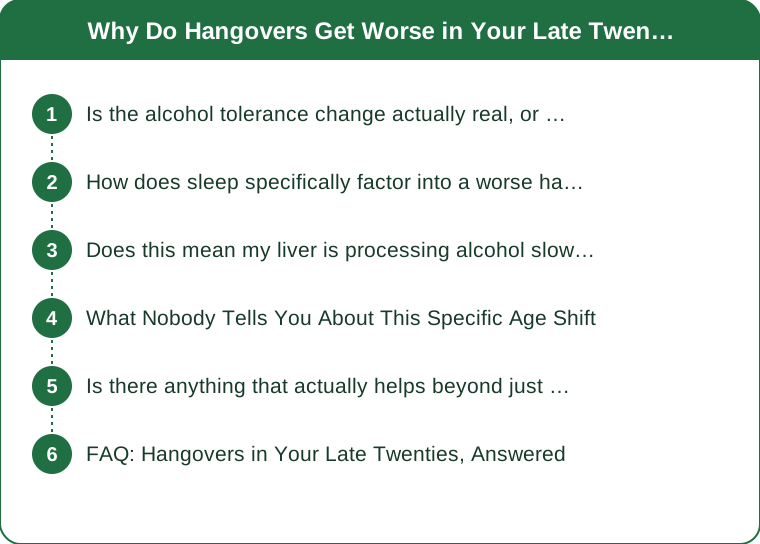
Is the alcohol tolerance change actually real, or is this just feeling different psychologically?
It’s measurably real. Total body water percentage, which dilutes blood alcohol concentration for a given amount consumed, gradually declines through your twenties as body composition shifts slightly, meaning the same drink produces a somewhat higher peak blood alcohol level than it did a few years earlier at the same body weight.
How does sleep specifically factor into a worse hangover?
Alcohol disrupts REM sleep regardless of age, but sleep architecture in general becomes lighter and more easily fragmented starting in the mid-to-late twenties for most people. A hangover that used to be buffered by a genuinely deep, restorative sleep now compounds with an already lighter sleep baseline, producing a rougher recovery.
Does this mean my liver is processing alcohol slower now?
Liver alcohol metabolism rate itself doesn’t change dramatically in this specific age window — the more significant factors are the body water and sleep quality changes above, not a major shift in liver processing speed this early. Liver metabolism changes more meaningfully later, past the twenties.

What Nobody Tells You About This Specific Age Shift
Most people attribute a worse hangover purely to ‘getting older’ in a vague sense, without realizing there’s a specific, identifiable window (mid-to-late twenties) where body water and sleep changes compound noticeably, rather than a smooth gradual decline starting at 21. That’s part of why the shift can feel sudden rather than gradual — because physiologically, it partly is.
Is there anything that actually helps beyond just drinking less?
Hydration before and during drinking, not just after, addresses the body water factor directly, since you’re starting from a better-hydrated baseline rather than trying to catch up the next morning. Prioritizing your sleep environment on a drinking night (consistent bedtime, cooler room) also helps offset the sleep disruption alcohol causes, even if it can’t fully prevent it.
FAQ: Hangovers in Your Late Twenties, Answered
Does food before drinking make as much of a difference as people say?
Yes, genuinely — eating before and during drinking slows alcohol absorption meaningfully, which is one of the more reliable, well-supported hangover mitigation strategies at any age.
Will this keep getting worse every year through my thirties?
Gradually, yes, for most people, though the rate of change varies significantly by individual factors like baseline hydration habits, sleep consistency, and overall health.
Is this a sign I should be concerned about my alcohol tolerance changing this fast?
Not on its own — a gradually rougher hangover in your late twenties is a normal physiological pattern, not necessarily a health red flag, though it’s a reasonable prompt to reassess how much you’re drinking regardless.
TL;DR:
- Declining total body water percentage in your mid-to-late twenties genuinely raises peak blood alcohol for the same amount consumed
- Naturally lighter sleep compounds with alcohol’s sleep disruption, worsening next-day recovery
- This isn’t primarily a liver metabolism change this early — body water and sleep are the bigger factors
- Hydrating before and during drinking, not just the next morning, addresses the root cause more directly
It’s not in your head — your body is genuinely processing the same night differently than it did a few years ago.
Keep Reading
This article is for general informational and styling purposes only. Fit, sizing, and product availability may vary.