Is What You're Feeling a Quarter-Life Crisis? Here's How to Tell — and What Actually Helps
Quick Answer: A quarter-life crisis typically shows up between ages 25-29 as a mix of career doubt, comparison anxiety, and a sense of falling behind an imagined timeline — it’s a normal developmental phase, not a personal failure, and it responds well to small structural changes rather than a total life overhaul.
If you’re 26 and suddenly questioning your job, your relationships, and whether you’re ‘doing life right,’ you’re not broken and you’re not alone — this specific wave of unease is common enough to have its own research base.

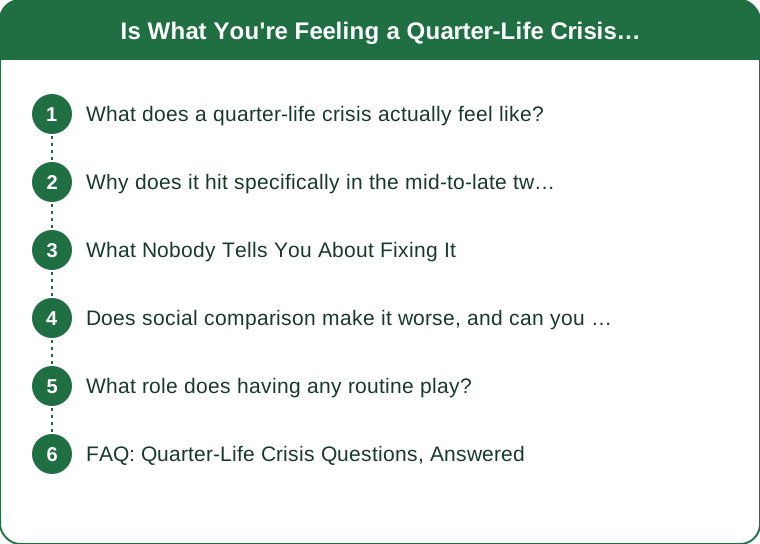
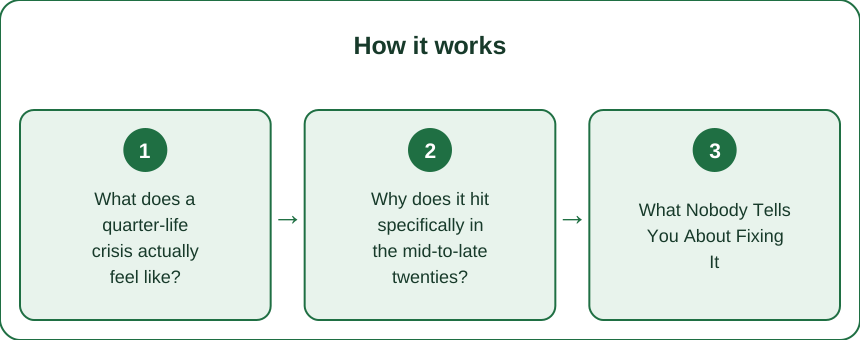
What does a quarter-life crisis actually feel like?
A persistent gap between where you expected to be and where you actually are — not a single bad day, but a recurring low-grade dread, often triggered by social comparison (weddings, promotions, home purchases showing up in your feed) and a sense that decisions made at 22 are now locking you into a path you’re not sure you chose.
Why does it hit specifically in the mid-to-late twenties?
This is the window where the structure of school ends and the structure of adult life hasn’t fully replaced it yet — you’re making identity-defining decisions with less external scaffolding than at any previous life stage, which naturally produces more uncertainty and self-questioning.
What Nobody Tells You About Fixing It
The instinct is to make a big change — quit the job, move cities, end the relationship. Big changes made from a place of crisis often just relocate the same underlying unease, because the crisis is usually about meaning and direction, not the specific job or city.
What tends to actually help: small, reversible experiments — a new hobby, a different weekly routine, one honest conversation about what you actually want versus what you think you should want. These smaller moves surface real information without the risk of a big, hard-to-reverse decision made under stress.

Does social comparison make it worse, and can you actually reduce it?
Significantly worse — curated social media timelines show other people’s highlight reels next to your unfiltered daily experience, which is not a fair comparison and your brain doesn’t naturally correct for that. A deliberate reduction in passive scrolling, even just during your lowest-mood hours of the day, measurably reduces comparison-driven anxiety for most people who try it.
What role does having any routine play?
A surprisingly large one. Structure gives your day predictable anchors when the bigger picture feels uncertain — even something as small as a consistent morning routine provides a sense of control that counters the broader feeling of drift.
FAQ: Quarter-Life Crisis Questions, Answered
Is a quarter-life crisis a real clinical thing or just a trend term?
It’s not a formal clinical diagnosis, but the pattern is well-documented in developmental psychology research as a recognizable phase many people move through in their mid-to-late twenties.
How long does it usually last?
Highly variable, but many people report the most acute phase easing within 6-12 months, especially once they make even small directional changes rather than staying stuck in analysis.
When should this become a conversation with a therapist instead of just ‘a phase’?
If the low-grade dread tips into persistent hopelessness, sleep disruption, or loss of interest in things you used to enjoy for more than a couple weeks, that’s worth a professional conversation — this is general information, not medical advice.
TL;DR:
- A quarter-life crisis is a common, well-documented pattern in the mid-to-late twenties — not a personal failure
- Small, reversible experiments beat big crisis-driven decisions like quitting a job or moving cities
- Reducing passive social media scrolling measurably eases comparison-driven anxiety
- Persistent hopelessness beyond a couple weeks is worth a professional conversation, not just self-help
Keep Reading
This article is for general informational and styling purposes only. Fit, sizing, and product availability may vary.