Why Skipping the Gym for Plans Doesn't Have to Feel Like Failure in Your Twenties
Quick Answer: One missed workout for social plans has essentially zero measurable fitness impact — the guilt spiral around it usually costs more mental energy than the missed session costs physically. Your twenties uniquely compress social opportunities into a narrow window that later decades don’t offer the same way, which makes the trade-off worth naming honestly instead of treated as a discipline failure.
You had a plan to hit the gym, and then a group chat lit up with plans that only work tonight — this specific group, this specific window, before someone moves or a relationship changes the dynamic. Skipping the workout feels like caving. It probably isn’t.

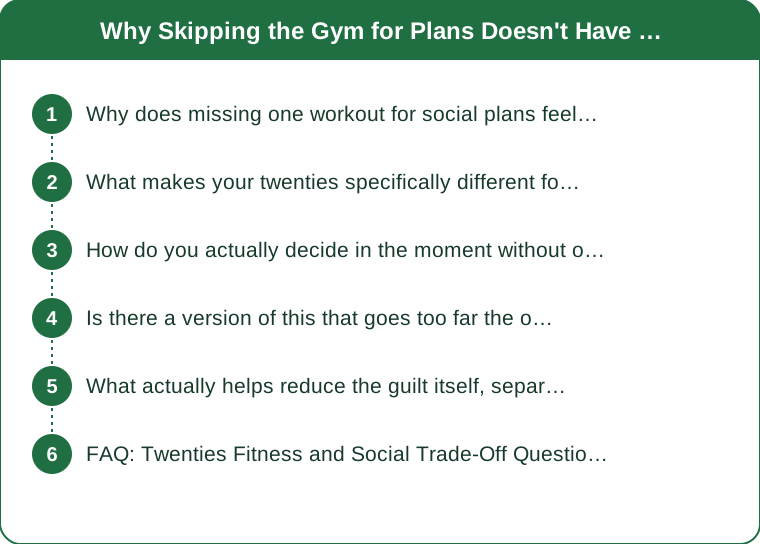
Why does missing one workout for social plans feel like such a big deal?
Because fitness culture frames consistency as an all-or-nothing identity marker, when physiologically a single missed session has no measurable effect on strength, endurance, or body composition over any meaningful timeframe. The guilt is doing more damage than the missed workout itself.
Is this different from skipping workouts habitually?
Yes — a pattern of skipping most sessions for most plans is a different conversation than an occasional trade-off. This is specifically about the guilt attached to occasional, deliberate choices, not chronic avoidance.
What makes your twenties specifically different for this trade-off?
Social windows in your twenties are often genuinely time-limited in a way they aren’t later — friend groups relocate, life stages diverge, and spontaneous plans get harder to coordinate once people partner up, have kids, or move for work. A missed workout can be rescheduled tomorrow; a specific group hangout at this specific life stage sometimes can’t be recreated the same way.
That’s not an excuse to never train — it’s a reason the trade-off deserves to be made consciously rather than treated as a moral failure either way.
How do you actually decide in the moment without over-analyzing it?
Ask whether this is a repeatable opportunity or a specific-window one. A standing weekly hangout can flex around your schedule; a one-time trip, a friend visiting, or a group that rarely aligns is closer to the specific-window category where skipping the gym is a reasonable, deliberate call.
Does it help to have a backup plan for the missed session?
Sometimes — a shorter session the next morning or a walk worked into the social plan itself can close the gap without requiring you to choose one thing at 100% and the other at zero.

Is there a version of this that goes too far the other direction?
Yes — if social plans are consistently overriding fitness every single week rather than occasionally, that’s a different pattern worth noticing, not because missing a workout is inherently bad, but because chronic avoidance often has a different root cause (burnout, lack of enjoyment in the current routine) worth addressing directly rather than through guilt.
The goal is an honest ratio, not a perfect one.
What actually helps reduce the guilt itself, separate from the decision?
Naming the trade-off out loud, even just to yourself — ‘I’m choosing this specific thing over the gym tonight, on purpose’ — tends to reduce the low-grade guilt that comes from feeling like discipline quietly failed. A conscious trade-off and an accidental lapse feel very different internally, even though the outcome (missed workout) is identical.
Does tracking consistency over months instead of days help with this?
Yes — looking at a monthly or quarterly pattern rather than a daily scorecard makes individual trade-off nights feel proportionate instead of catastrophic.
FAQ: Twenties Fitness and Social Trade-Off Questions, Answered
Does one missed workout actually set back fitness progress?
No — a single session has no measurable long-term effect; the pattern across weeks and months is what matters, not any individual night.
How do I stop feeling guilty about choosing plans over the gym?
Naming the choice consciously, rather than letting it feel like an accidental failure, is the most effective shift most people report.
Is it worth trying to fit in a shorter workout before or after plans?
If it’s easy and doesn’t add stress to the night, sure — but it’s optional, not a requirement to ‘earn’ the social time.
TL;DR:
- A single missed workout has no measurable fitness impact — the guilt costs more than the session
- Twenties social windows are often genuinely time-limited in a way later decades aren’t
- Distinguish repeatable hangouts from specific-window opportunities when deciding
- Naming the trade-off consciously reduces guilt more than trying to avoid the trade-off entirely
Missing a workout for a specific, hard-to-repeat plan isn’t a discipline failure — it’s a trade-off worth making on purpose, occasionally, without the spiral.
Keep Reading
This article is for general informational and styling purposes only. Fit, sizing, and product availability may vary.