Strength Training in Your Twenties: The Questions Nobody Actually Answers
Quick Answer: Two full-body sessions a week is the honest minimum that produces real strength and bone adaptation in your twenties, and three is where most people find the sweet spot. Your twenties matter more than any other decade for lifting because peak bone mass is set by roughly age 30 - and unlike muscle, you cannot fully rebuild it later.
Everybody tells you to lift. Almost nobody tells you how much, for how long, or what happens if you skip the decade entirely.
So you get vague encouragement, a program from the internet, four good months, and then a plateau nobody warned you about.
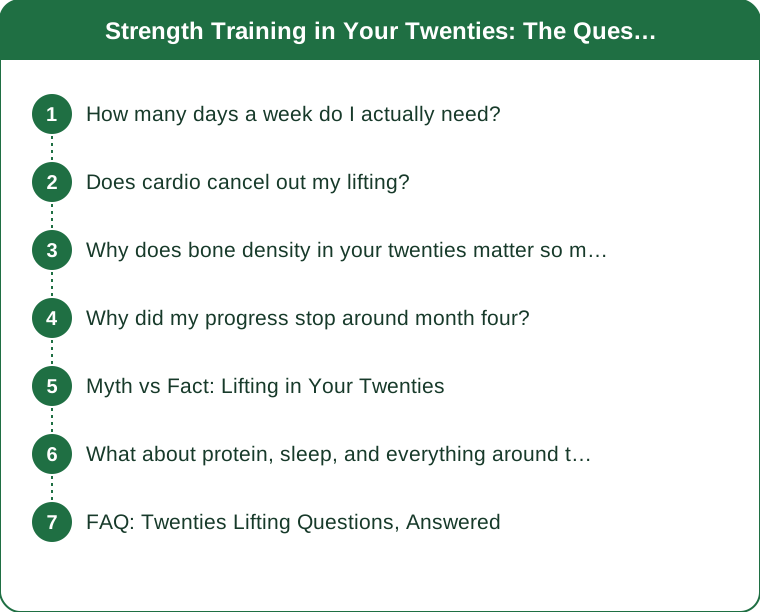
Here are the questions that actually come up, in the order they usually come up.

How many days a week do I actually need?
Two full-body sessions per week is the threshold where meaningful strength and bone adaptations reliably show up. Three is better if the schedule allows. Beyond four, returns get small fast for anyone not competing.
The common trap is designing a five-day split you can hold for three weeks instead of a two-day plan you can hold for three years. Consistency compounds; ambition does not.
What if I only have two 30-minute slots?
That is enough. Three compound movements per session - a squat pattern, a hinge or pull, and a press - at 3 sets of 5-8 covers the majority of the benefit.
Does cardio cancel out my lifting?
Not at the volumes most people do. The interference effect is real but it becomes meaningful at high endurance volumes - think several hours of hard cardio weekly - not at three runs or a couple of spin classes.
What helps: put hard cardio and hard lifting on different days when you can, or separate them by at least six hours on the same day. If they must be back to back, lift first when strength is the priority.
Should I do cardio at all if I want to build muscle?
Yes. Cardiovascular fitness in your twenties tracks with health outcomes decades later, and better aerobic capacity means faster recovery between sets.
Why does bone density in your twenties matter so much?
This is the part that gets buried. Bone mass accumulates through adolescence and the early twenties, peaks somewhere around age 25-30, and then very slowly declines. The peak you reach is the balance you draw down for the rest of your life.
Resistance training and impact loading during that accumulation window increases the peak. Nothing in later life fully makes up the difference - later training slows the decline, which is valuable, but it does not rebuild what was never deposited.
What builds bone specifically: loaded, weight-bearing, higher-force work. Squats, deadlifts, presses, jumping, running. Swimming and cycling are excellent for other things and do close to nothing for bone.
How much is enough for bone?
The same two to three sessions. Bone responds to load magnitude more than to volume, so heavier sets of 5-8 do more per minute than long sets of 20.

Why did my progress stop around month four?
Because the beginner phase ended, which is a good thing dressed as a bad one. The first few months bring rapid gains that are largely neurological - your nervous system learning to recruit muscle efficiently. That well runs dry.
After that, progress requires progressive overload with actual bookkeeping: adding weight, adding reps, or improving control, and writing it down. Doing the same three sets of ten forever is maintenance, not training.
A simple structure that keeps working: add 2.5-5 lbs to a lift when you hit the top of your rep range on all sets with good form. Slow, boring, and it compounds.
Should I change programs when I plateau?
Usually not. Most plateaus are under-loading, under-eating, or under-sleeping - not the wrong program. Change one input at a time before changing the whole plan.
Myth vs Fact: Lifting in Your Twenties
Myth: Lifting heavy makes women bulky. Fact: Hypertrophy is slow and requires a caloric surplus plus years of consistency. The people who look how they want from lifting worked deliberately at it.
Myth: You need to be sore for it to count. Fact: Soreness tracks novelty, not effectiveness. Your best training months will produce less soreness than your first two weeks.
Myth: You should train to failure every set. Fact: Stopping 1-3 reps short on most sets produces comparable gains with far less fatigue, which means more quality sessions per month.
Myth: Your twenties are so forgiving that technique does not matter yet. Fact: Your twenties are when you build the movement patterns you will repeat 50,000 times. This is exactly when technique matters most.
What about protein, sleep, and everything around the lifting?
The two that move the needle:
- Protein. Roughly 0.7-1g per pound of body weight daily supports muscle building. Most people under-eat it, particularly at breakfast. A 30g protein breakfast changes the whole day’s total.
- Sleep. Adaptation happens during sleep. Chronic short sleep blunts strength gains and increases injury risk, and it is the most commonly wrecked variable in your twenties.
Everything else - supplements, timing windows, specific meal composition - is rounding error until those two are handled.
This is general information, not medical advice. If you have a history of eating disorders, joint problems, or any medical condition, talk to a professional before starting a loading program.
FAQ: Twenties Lifting Questions, Answered
Is it too late if I am 28 and never lifted?
No. You will still add strength and muscle at close to the same rate, and you can still add to peak bone mass in the last years of the window. Starting at 28 beats starting at 38 by a decade of compounding.
Do I need a gym membership?
No, but you need progressive load. Bodyweight work stalls quickly for lower body strength. Adjustable dumbbells or a barbell setup at home solves it.
How long until I see changes?
Strength numbers move in 2-4 weeks. Visible changes typically take 8-12 weeks and depend heavily on nutrition. The bone and metabolic benefits start before you can see anything at all.
TL;DR:
- Two full-body sessions weekly is the real minimum; three is the sweet spot.
- Peak bone mass locks in around 25-30 - this decade is the only one where you can add to the ceiling rather than slow the decline.
- Cardio only interferes at high volumes. Separate hard sessions by six hours when you can.
- Month four is the end of the beginner phase, not the end of progress. Start writing weights down.
- Protein around 0.7-1g per pound and adequate sleep beat every supplement.
Your twenties are not the decade when lifting matters least because you can get away with anything. They are the decade when it matters most, because it is the only window where you are still setting the ceiling instead of defending it.
Keep Reading
This article is for general informational and styling purposes only. Fit, sizing, and product availability may vary.