Why Making Time to Work Out Gets Harder Every Year of Your Twenties
Quick Answer: Early twenties often come with school schedules, gym-adjacent social routines, and fewer competing responsibilities that make working out easier without much deliberate effort — as those built-in structures gradually disappear through the decade, staying consistent takes noticeably more intentional planning than it used to.
Working out used to just happen — a class with friends, a schedule with built-in gaps. Somewhere in the middle of your twenties, none of that structure is there anymore, and consistency suddenly takes actual effort.

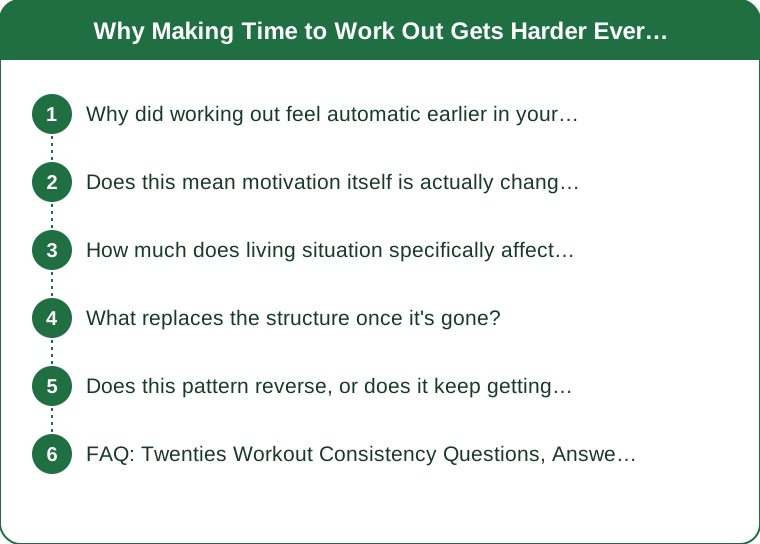
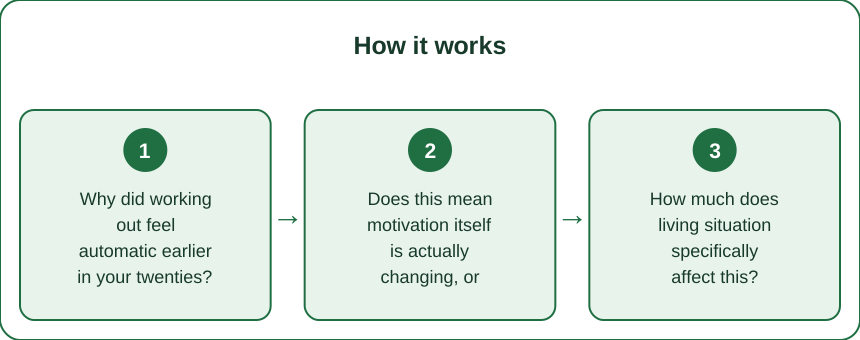
Why did working out feel automatic earlier in your twenties?
School and early-career schedules often have more predictable, structured time blocks, and social routines (living near friends, group fitness classes, campus gyms) build exercise into the week without requiring much independent planning. This structure quietly erodes as careers, relationships, and living situations shift.
Does this mean motivation itself is actually changing, or something else?
Usually something else — the external structure that used to make working out low-effort disappears, requiring motivation to now do work that structure previously handled. It’s easy to misread this shift as declining motivation when it’s really a loss of environmental support.
How much does living situation specifically affect this?
A lot — moving out of shared housing or away from a walkable gym or studio removes friction-reducing proximity that made workouts easy to fit in casually. Research on exercise adherence consistently identifies convenience and proximity as some of the strongest predictors of consistency, more than motivation alone.

What replaces the structure once it’s gone?
Scheduling workouts like fixed appointments, rather than relying on spontaneous energy or leftover time, tends to restore the reliability that natural structure used to provide. Finding a new consistent social or accountability layer — even a single recurring workout partner — replicates some of what built-in social structure used to do automatically.
Does this pattern reverse, or does it keep getting harder?
For most people it stabilizes once new structure is deliberately rebuilt, rather than continuing to get harder indefinitely — the difficulty is specifically tied to structure disappearing, not to age itself, so rebuilding structure genuinely fixes the underlying issue.
FAQ: Twenties Workout Consistency Questions, Answered
Is it normal for consistency to dip during a major life transition like a move or new job?
Yes, very common — transitions temporarily remove existing structure before new structure has had time to form, and consistency often naturally dips during that gap.
Does having a workout buddy actually help as much as it seems to?
Research on exercise adherence consistently shows accountability partners meaningfully improve consistency, largely by replicating the built-in social structure that made earlier exercise habits easier.
Should the workout itself change as schedules get busier, or just the scheduling approach?
Often just the scheduling and structure need to adapt — shorter, more flexible workout formats can help, but the core issue is usually consistency structure, not the workout content itself.
TL;DR:
- Early twenties routines often have built-in structure — school schedules, proximity, social workout habits — that isn’t really about motivation
- That structure gradually disappearing, not declining motivation, is usually why consistency gets harder
- Living situation and proximity to a gym are some of the strongest real predictors of consistency
- Deliberately scheduling workouts and rebuilding a social accountability layer restores what natural structure used to provide
It’s not that you care less about working out than you did at 22 — the structure that made it easy quietly disappeared, and rebuilding it on purpose is what actually fixes consistency.
Keep Reading
This article is for general informational and styling purposes only. Fit, sizing, and product availability may vary.